There are many homophones in the English language, which can be confusing for ESL students. This list of 1000 homophones will help you learn and understand these words better.
Our list of 1000 homophones will help you spot these playful word twins and understand them better. This way, learning English becomes more fun and less confusing. Whether you’re just starting or looking to polish your skills, this list is your friendly guide to mastering these sound-alike words.
Start Here: Twelve Homophone Pairs Everyone Mixes Up
| Pair | What each word means |
|---|---|
| ate / eight | ate means consumed food; eight is the number 8. |
| brake / break | A brake stops a vehicle; to break is to snap or shatter something. |
| buy / by | To buy is to purchase; by means next to, or done by someone. |
| flour / flower | Flour is the powder for baking; a flower is the blooming part of a plant. |
| hear / here | To hear is to listen; here means this place. |
| its / it’s | Its shows belonging; it’s is a short form of “it is.” |
| know / no | To know is to understand; no means not yes. |
| pair / pear | A pair is two of something; a pear is a sweet fruit. |
| right / write | Right means correct or the opposite of left; to write is to put words on paper. |
| see / sea | To see is to look; the sea is the ocean. |
| sun / son | The sun is the star in our sky; a son is a male child. |
| their / there | Their shows belonging to them; there points to a place. |
| to / too / two | To points direction; too means also or too much; two is the number 2. |
| wear / where | To wear is to have clothes on; where asks about a place. |
| week / weak | A week is seven days; weak means not strong. |
Pairs That Catch Writers Out
- The brake failed, so I had to break my fall with both hands.
- Do you hear the rain out here?
- Their car is parked over there, by the gate.
- She will wear the red dress, but she cannot remember where she bought it.
- I know the answer is no, and I am fine with that.
Most homophone mistakes happen because the two words sound identical in speech. When you write, stop for one second and picture the meaning, not the sound.
One quick note for readers in Britain, Canada, Australia, and New Zealand: a few pairs below depend on American spelling or pronunciation. Pairs built on words like licence/license or cheque are marked with the British spelling in some lists, and pairs like aren’t/aunt only line up as homophones in some accents. As you read, ask whether the pair sounds the same in your own accent; if it does not, it is a spelling pair, not a sound pair, for you.
Homophones Words List
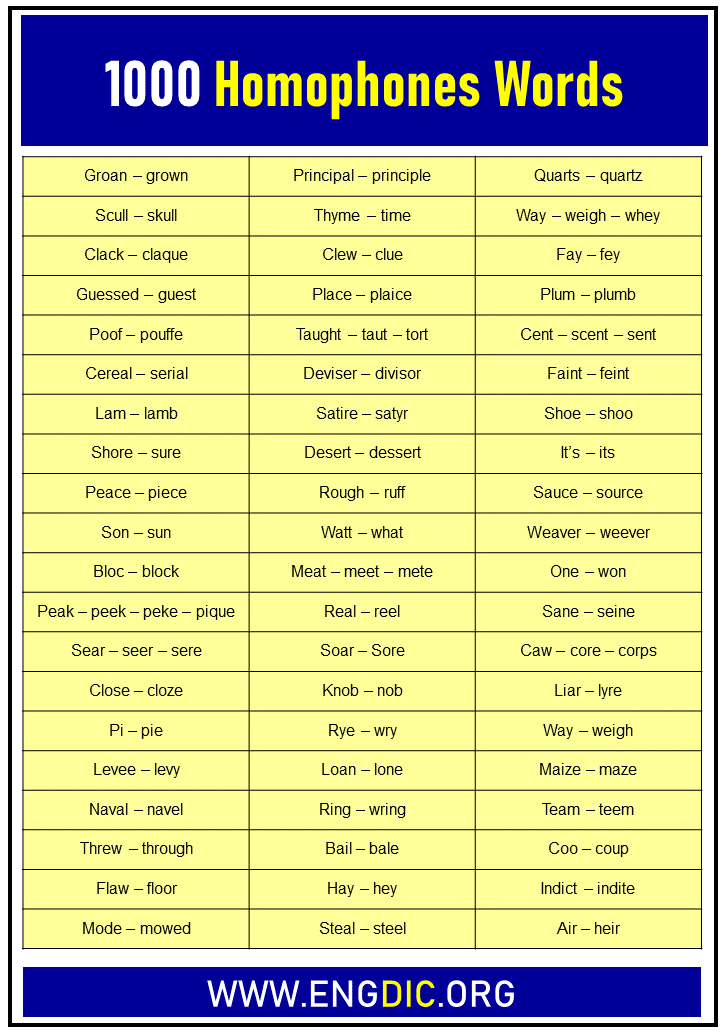
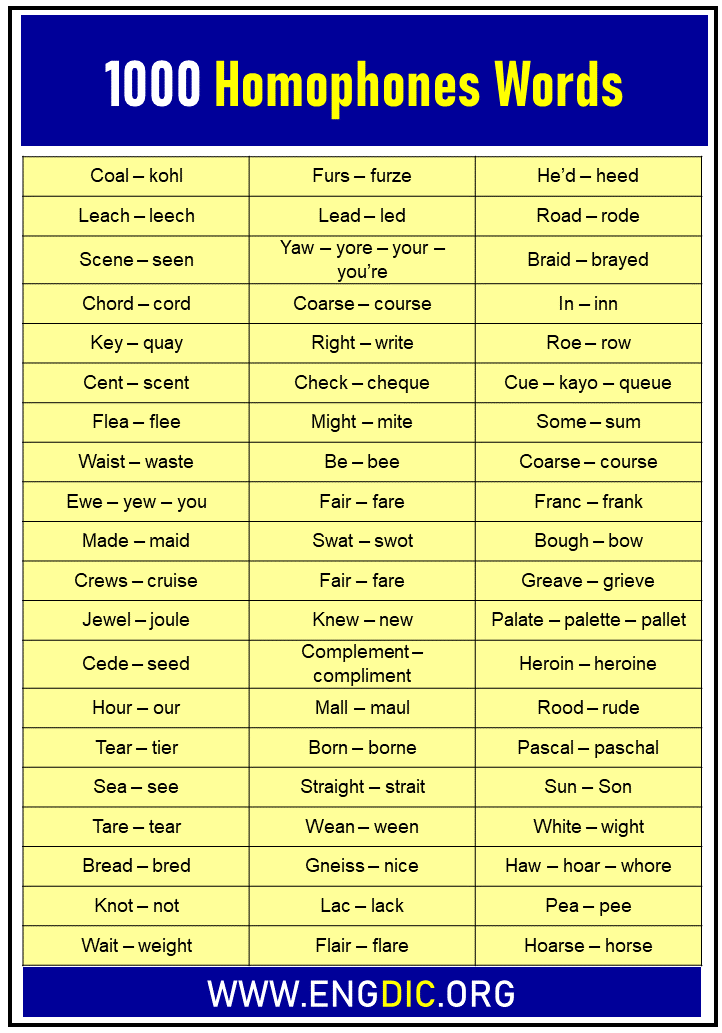
Here is a huge list of homophone in english:
- Accessary – Accessory
- Ad – Add
- Ail – Ale
- Air – Heir
- Aisle – Isle
- All – Awl
- Allowed – Aloud
- Alms – Arms
- Altar – Alter
- Ante –
- Arc – Ark
- Aren’t – Aunt
- Ate – Eight
- Auger – Augur
- Auk – Orc
- Aural – Oral
- Away – Aweigh
- Awe – Oar
- Axel – Axle
- Aye – Eye
- Bail – Bale
- Bait – Bate
- Baize – Bays
- Bald – Bawled
- Ball – Bawl
- Band – Banned
- Bard – Barred
- Bare – Bear
- Bark – Barque
- Baron – Barren
- Base – Bass
- Bay – Bey
- Bazaar – Bizarre
- Be – Bee
- Beach – Beech
- Bean – Been
- Beat – Beet
- Beau – Bow
- Beer – Bier
- Bel – Bell
- Berry – Bury
- Berth – Birth
- Bight – Bite
- Billed – Build
- Bitten – Bittern
- Blew – Blue
- Bloc – Block
- Boar – Bore
- Board – Bored
- Boarder – Border
- Bold – Bowled
- Boos – Booze
- Born – Borne
- Bough – Bow
- Boy – Buoy
- Brae – Bray
- Braid – Brayed
- Braise – Brays
- Brake – Break
- Bread – Bred
- Brews – Bruise
- Bridal – Bridle
- Broach – Brooch
- Bur – Burr
- But – Butt
- Buy – By
- Buy – By
- Buyer – Byre
- Calendar – Calender
- Call – Caul
- Canvas – Canvass
- Cast – Caste
- Caster – Castor
- Caught – Court
- Caw – Core
- Cede – Seed
- Ceiling – Sealing
- Cell – Sell
- Censer – Censor
- Cent – Scent
- Cent – Scent
- Cereal – Serial
- Cheap – Cheep
- Check – Cheque
- Choir – Quire
- Chord – Cord
- Cite – Sight
- Clack – Claque
- Clew – Clue
- Climb – Clime
- Close – Cloze
- Coal – Kohl
- Coarse – Course
- Coign – Coin
- Colonel – Kernel
- Complacent – Complaisant
- Complement – Compliment
- Coo – Coup
- Cops – Copse
- Council – Counsel
- Cousin – Cozen
- Creak – Creek
- Crews – Cruise
- Cue – Kayo
- Curb – Herb
- Currant – Current
- Cymbal – Symbol
- Dam – Damn
- Days – Daze
- Dear – Deer
- Desert – Dessert
- Deviser – Divisor
- Dew – Due
- Die – Dye
- Discreet – Discrete
- Doe – Doh
- Done – Dun
- Douse – Dowse
- Draft – Draught
- Dual – Duel
- Earn – Urn
- Eery – Eyrie
- Ewe – Yew
- Eye – I
- Fah – Far
- Faint – Feint
- Fair – Fare
- Farther – Father
- Fate – Fête
- Faun – Fawn
- Fay – Fey
- Faze – Phase
- Feat – Feet
- Ferrule – Ferule
- Few – Phew
- Fie – Phi
- File – Phial
- Find – Fined
- Fir – Fur
- Fizz – Phiz
- Flair – Flare
- Flaw – Floor
- Flea – Flee
- Flew – Flu
- Flex – Flecks
- Floe – Flow
- Flour – Flower
- Foaled – Fold
- For – Fore
- For – Four
- Foreword – Forward
- Fort – Fought
- Forth – Fourth
- Foul – Fowl
- Franc – Frank
- Freeze – Frieze
- Friar – Fryer
- Furs – Furze
- Gait – Gate
- Galipot – Gallipot
- Gallop – Galop
- Gamble – Gambol
- Gays – Gaze
- Genes – Jeans
- Gild – Guild
- Gilt – Guilt
- Giro – Gyro
- Gnaw – Nor
- Gneiss – Nice
- Gorilla – Guerilla
- Grate – Great
- Greave – Grieve
- Greys – Graze
- Grisly – Grizzly
- Groan – Grown
- Guessed – Guest
- Hail – Hale
- Hair – Hare
- Hall – Haul
- Hangar – Hanger
- Hart – Heart
- Haw – Hoar
- Hay – Hey
- Heal – Heel
- Heal – Heel
- Hear – Here
- Heard – Herd
- Heroin – Heroine
- Hew – Hue
- He’d – Heed
- Hi – High
- Higher – Hire
- Him – Hymn
- Ho – Hoe
- Hoard – Horde
- Hoarse – Horse
- Hole – Whole
- Holey – Holy
- Hour – Our
- Idle – Idol
- In – Inn
- Indict – Indite
- It’s – Its
- Jewel – Joule
- Key – Quay
- Knave – Nave
- Knead – Need
- Knew – New
- Knight – Night
- Knit – Nit
- Knob – Nob
- Knock – Nock
- Knot – Not
- Know – No
- Knows – Nose
- Laager – Lager
- Lac – Lack
- Lade – Laid
- Lain – Lane
- Lam – Lamb
- Laps – Lapse
- Larva – Lava
- Lase – Laze
- Law – Lore
- Lay – Ley
- Lea – Lee
- Leach – Leech
- Lead – Led
- Leak – Leek
- Lean – Lien
- Lessen – Lesson
- Levee – Levy
- Liar – Lyre
- Licence – License
- Licker – Liquor
- Lie – Lye
- Lieu – Loo
- Links – Lynx
- Lo – Low
- Load – Lode
- Loan – Lone
- Locks – Lox
- Loop – Loupe
- Loot – Lute
- Made – Maid
- Mail – Male
- Main – Mane
- Maize – Maze
- Mall – Maul
- Manna – Manner
- Mantel – Mantle
- Mare – Mayor
- Mark – Marque
- Marshal – Martial
- Marten – Martin
- Mask – Masque
- Maw – More
- Me – Mi
- Mean – Mien
- Meat – Meet
- Meat – Meet
- Medal – Meddle
- Metal – Mettle
- Meter – Metre
- Might – Mite
- Mind – Mined
- Miner – Minor
- Missed – Mist
- Moat – Mote
- Mode – Mowed
- Moor – More
- Moose – Mousse
- Morning – Mourning
- Muscle – Mussel
- Naval – Navel
- Nay – Neigh
- Nigh – Nye
- None – Nun
- Oar – Or
- Od – Odd
- Ode – Owed
- Oh – Owe
- One – Won
- Packed – Pact
- Packs – Pax
- Pail – Pale
- Pain – Pane
- Pair – Pare
- Pair – Pear
- Palate – Palette
- Pascal – Paschal
- Paten – Patten
- Pause – Paws
- Pawn – Porn
- Pea – Pee
- Peace – Piece
- Peak – Peek
- Peal – Peel
- Pearl – Purl
- Pedal – Peddle
- Peer – Pier
- Pi – Pie
- Pica – Pika
- Place – Plaice
- Plain – Plane
- Pleas – Please
- Plum – Plumb
- Pole – Poll
- Poof – Pouffe
- Poor – Pour
- Practice – Practise
- Praise – Prays
- Pray – Prey
- Principal – Principle
- Profit – Prophet
- Quarts – Quartz
- Quean – Queen
- Rain – Reign
- Raise – Rays
- Rap – Wrap
- Raw – Roar
- Read – Red
- Read – Reed
- Real – Reel
- Reek – Wreak
- Rest – Wrest
- Retch – Wretch
- Review – Revue
- Rheum – Room
- Right – Rite
- Right – Write
- Ring – Wring
- Road – Rode
- Rode – Road
- Roe – Row
- Role – Roll
- Roo – Roux
- Rood – Rude
- Root – Route
- Rose – Rows
- Rota – Rotor
- Rote – Wrote
- Rough – Ruff
- Rouse – Rows
- Rung – Wrung
- Rye – Wry
- Sail – Sale
- Sale – Sail
- Sane – Seine
- Satire – Satyr
- Sauce – Source
- Saver – Savour
- Saw – Soar
- Scene – Seen
- Scull – Skull
- Sea – See
- Seam – Seem
- Sear – Seer
- Seas – Sees
- See – Sea
- Sew – So
- Sew – So
- Shake – Sheikh
- Shear – Sheer
- Shoe – Shoo
- Shore – Sure
- Sic – Sick
- Side – Sighed
- Sight – Site
- Sign – Sine
- Sink – Synch
- Slay – Sleigh
- Sloe – Slow
- Soar – Sore
- Sole – Soul
- Some – Sum
- Son – Sun
- Sort – Sought
- Spa – Spar
- Spade – Spayed
- Staid – Stayed
- Stair – Stare
- Stake – Steak
- Stalk – Stork
- Stare – Stair
- Stationary – Stationery
- Steal – Steel
- Stile – Style
- Storey – Story
- Straight – Strait
- Suite – Sweet
- Sun – Son
- Swat – Swot
- Sweet – Suite
- Tacks – Tax
- Tail – Tale
- Tale – Tail
- Talk – Torque
- Tare – Tear
- Taught – Taut
- Te – Tea
- Team – Teem
- Tear – Tier
- Teas – Tease
- Terce – Terse
- Tern – Turn
- Their – There
- There – Their
- Threw – Through
- Throes – Throws
- Throne – Thrown
- Thyme – Time
- Tic – Tick
- Tide – Tied
- Tire – Tyre
- To – Too
- To – Too
- Toad – Toed
- Toe – Tow
- Told – Tolled
- Tole – Toll
- Ton – Tun
- Tor – Tore
- Tough – Tuff
- Troop – Troupe
- Tuba – Tuber
- Vain – Vane
- Vale – Veil
- Vial – Vile
- Wail – Wale
- Wain – Wane
- Waist – Waste
- Wait – Weight
- Waive – Wave
- Wall – Waul
- War – Wore
- Ware – Wear
- Warn – Worn
- Wart – Wort
- Watt – What
- Wax – Whacks
- Way – Weigh
- Way – Weigh
- We – Wee
- Weak – Week
- Weal – We’ll
- Wean – Ween
- Wear – Where
- Weather – Whether
- Weaver – Weever
- Weir – We’re
- Were – Whirr
- Wet – Whet
- We’d – Weed
- Wheald – Wheeled
- Which – Witch
- Whig – Wig
- While – Wile
- Whine – Wine
- Whirl – Whorl
- Whirled – World
- Whit – Wit
- White – Wight
- Who’s – Whose
- Woe – Whoa
- Wood – Would
- Yaw – Yore
- Yoke – Yolk
- You’ll – Yule
Homophones with Meanings & Sentences
Here is the A to Z list of homophones with meanings and example sentences:

- Accessary: (An accomplice) The thief’s accessary was waiting in the car.
- Accessory: (An additional item) She wore a beautiful accessory with her dress.
- Ad: (Advertisement) I saw an interesting ad in the newspaper today.
- Add: (To combine or join) Let’s add these numbers to get the total.
- Ail: (To suffer or be ill) Something seems to ail him today.
- Air: (The invisible gaseous substance) Fresh air is vital for good health.
- Aisle: (A passage between rows) Please walk down the aisle to your seat.
- Ale: (A type of beer) He ordered a pint of ale at the pub.
- All: (Everything) All the guests have arrived.
- Allowed: (Permitted) Visitors are not allowed in this area.
- Alms: (Money or food given to poor people) She gave alms to the needy.
- Aloud: (Out loud) She read the poem aloud to the class.
- Altar: (A sacred table in a church) They stood by the altar to take their vows.
- Alter: (To change) She decided to alter her plans.
- Ante: (A stake put up in poker) He upped the ante in the poker game.
- Arc: (A part of the circumference of a circle) The rainbow formed a perfect arc.
- Aren’t: (Are not) They aren’t going to the party.
- Ark: (A chest or vessel) Noah built an ark as per the biblical tale.
- Arms: (Weapons or limbs) Soldiers took up arms to defend the city.
- Ate: (Past tense of eat) We ate dinner at 7 PM.
- Auger: (A tool for boring holes) He used an auger to drill the wood.
- Augur: (To predict) The signs augur well for the future.
- Auk: (A type of bird) The auk is known for its diving ability.
- Aunt: (The sister of one’s parent) My aunt is visiting us next week.
- Aural: (Relating to the ear or hearing) She has a keen aural sense for music.
- Away: (Not here or to a distance) He is away on a business trip.
- Awe: (A feeling of reverential respect) The grandeur of the mountains filled him with awe.
- Aweigh: (Referring to an anchor when it is lifted from the seabed) Anchors aweigh, we’re setting sail!
- Awl: (A pointed tool) The cobbler used an awl for the leather.
- Axel: (A jump in figure skating) The skater executed a perfect axel.
- Axle: (A rod or spindle passing through the center of a wheel) The car’s axle broke during the race.
- Aye: (Yes, used in voting) The captain said “aye” to the proposal.
- Bail: (A temporary release of an accused person) He was released on bail.
- Bait: (Something used to entice fish or animals) He put bait on the hook.
- Baize: (A green cloth) The baize on the pool table was worn out.
- Bald: (Lacking hair) His bald head shone in the sunlight.
- Bale: (A large bundle) A bale of cotton weighed heavily on the scale.
- Bate: (To lessen or reduce) He waited with bated
- Bawled: (Cried loudly) The child bawled for hours.
- Bays: (Inlets of the sea or voices of hounds) The moonlight shimmered over the bays.
- Eight: (The number after seven) There are eight planets in the solar system.
- Eye: (The organ of vision) He has a sharp eye for detail.
- Heir: (A person legally entitled to property) The prince was the heir to the throne.
- Isle: (An island) The isle looked stunning in the sunlight.
- Oar: (A tool used to row a boat) He lost an oar while rowing.
- Oral: (Spoken rather than written) The exam includes an oral
- Orc: (A mythical creature often depicted in fantasy literature) The story featured a fearsome orc.
- Ball: (a round object used in games) The children kicked the ball around the park.
- Band: (a group of musicians) The band played a captivating melody.
- Banned: (forbidden) Smoking is banned in all indoor public places.
- Bard: (a poet, traditionally one reciting epics) The ancient bard recited tales of heroism.
- Bare: (uncovered) The walls of the room were bare and devoid of decoration.
- Bark: (the sound a dog makes; also, the outer covering of a tree) The dog’s bark echoed through the silent night.
- Baron: (a rank of nobility) The baron owned vast lands across the valley.
- Barque: (a type of sailing ship) The old barque rested at the harbor, telling stories of the sea.
- Barred: (prevented from entering) The door was barred, keeping everyone out.
- Barren: (not productive) The barren landscape stretched for miles, with no sign of life.
- Base: (the bottom support; also, not morally good) The base of the statue was made of marble.
- Bass: (a type of fish; also, the lowest male singing voice) He caught a large bass during the fishing trip.
- Bawl: (to cry loudly) She began to bawl after hearing the sad news.
- Bay: (a broad inlet of the sea) The ship sailed into the calm waters of the bay.
- Bazaar: (a marketplace) The bazaar was bustling with people looking for exotic goods.
- Be: (to exist) To be or not to be, that is the question.
- Beach: (a sandy shore) The beach was warm and inviting under the summer sun.
- Bean: (a type of seed or vegetable) She added some beans to the stew for extra protein.
- Bear: (to carry; also, a large mammal) It’s hard to bear the weight of so many responsibilities.
- Beat: (to defeat; also, a rhythmic pulse) The drummer set the beat for the band.
- Beau: (a boyfriend or male admirer) Her beau brought flowers to their date.
- Bee: (an insect known for making honey) The bee buzzed from flower to flower.
- Beech: (a type of tree) The beech tree’s leaves turned golden in autumn.
- Been: (past participle of “be”) I have been to Paris twice.
- Beer: (an alcoholic beverage made from grains) He ordered a pint of beer at the pub.
- Beet: (a root vegetable) She chopped up a beet for the salad.
- Bel: (a unit of sound intensity) The engine’s roar was measured in bels.
- Bell: (a hollow instrument that makes a ringing sound) The bell rang to signal the end of the class.
- Berry: (a small, round fruit) She picked berries in the forest.
- Berth: (a bed on a ship or train; also, a space where a vessel can be moored) He booked a berth on the overnight train.
- Bey: (a Turkish title of respect) The bey was known for his wisdom and fairness.
- Bier: (a stand on which a corpse or a coffin is placed) The bier was carried through the streets in the funeral procession.
- Bight: (a bend or curve in a coastline) The map showed a large bight along the coast.
- Billed: (charged) – The customer was billed for the services rendered.
- Birth: (the act or process of bearing or bringing forth offspring) The birth of their first child was a joyous event.
- Bite: (to cut, wound, or tear with the teeth) Be careful, the dog might bite.
- Bitten: (attacked with teeth) – She was bitten by a stray dog.
- Bittern: (a type of bird) – A bittern was spotted in the marshlands.
- Bizarre: (strange) The circus showcased the most bizarre acts from around the world.
- Blew: (past tense of blow) – The wind blew strongly last night.
- Bloc: (a group with a common purpose) – The trade bloc agreed on new policies.
- Block: (to obstruct) – The fallen tree block the road.
- Blue: (a color) – The sky is exceptionally blue today.
- Boar: (a wild pig) – A wild boar was seen roaming the forest.
- Board: (a flat piece of material) – She cut the vegetables on a wooden board.
- Boarder: (someone who receives meals and lodging) – The new boarder moved in yesterday.
- Bold: (courageous or prominent) – Her bold ideas impressed the committee.
- Boos: (sounds of disapproval) The audience issued boos at the end of the performance.
- Booze: (alcoholic beverages) He indulged in too much booze at the party last night.
- Border: (the edge or boundary) – The river forms the natural border between the two countries.
- Bore: (to make someone weary) – The long lecture bore the students.
- Bored: (feeling weary) – He was bored during the long flight.
- Born: (past participle of bear) She was born in the month of June.
- Borne: (carried or transported) The weight of responsibility was borne by him alone.
- Bough: (a branch of a tree) The bird perched on the sturdy bough.
- Bow: (to bend forward at the waist) He gave a respectful bow to the king.
- Bow: (to bend forward; also, the front of a ship) He gave a bow after his performance.
- Bowled: (played in a bowling game or threw a ball in cricket) – He bowled a perfect strike in the last frame.
- Boy: (young male) The boy ran excitedly towards the playground.
- Brae: (a hillside) They had a picnic on the grassy brae overlooking the valley.
- Braid: (a woven strip of material) She wore a beautiful braid in her hair.
- Braise: (to cook slowly in liquid) She decided to braise the meat for dinner.
- Brake: (a device for slowing or stopping motion) He pressed the brake pedal to stop the car.
- Bray: (the cry of a donkey) The donkey let out a loud bray early in the morning.
- Brayed: (the past tense of bray) The donkey brayed loudly in the field.
- Brays: (the plural form of bray) The farm echoed with the brays of the donkeys.
- Bread: (a staple food made from flour) She made delicious bread from scratch.
- Break: (to separate into pieces) He needed a break after working all day.
- Bred: (past tense of breed) The dogs were bred for their loyalty and intelligence.
- Brews: (plural form of brew) They sampled different brews at the beer festival.
- Bridal: (related to a wedding) The bridal party walked down the aisle.
- Bridle: (headgear for controlling a horse) She gently adjusted the bridle on the horse.
- Broach: (to bring up for discussion) He decided to broach the topic during the meeting.
- Brooch: (a decorative pin) She wore a stunning brooch on her coat.
- Bruise: (a discoloration of the skin) She had a purple bruise on her arm from the fall.
- Build: (to construct) – They plan to build a new house next year.
- Buoy: (a floating marker) The red buoy marked the entrance to the harbor.
- Bur: (a rough, prickly seed covering) The bur stuck to his sweater after walking through the field.
- Burr: (a rough edge or point) He smoothed out the burr on the wood with sandpaper.
- Bury: (to place in the ground and cover) They decided to bury the time capsule in the backyard.
- But: (used to introduce a contrast) She wanted to go, but he preferred to stay home.
- Butt: (the end part of something) He stubbed his toe on the wooden butt of the bed.
- Buy: (to purchase something) She decided to buy a new dress for the party.
- Buy: (to purchase something) They plan to buy a new car next month.
- Buyer: (one who purchases) The buyer inspected the house carefully before making an offer.
- By: (next to or beside) He stood quietly by the door.
- By: (next to or beside) The park is located by the river.
- Byre: (a cowshed) The cows were kept in the byre overnight.
- Calendar: (a system of organizing days) She marked the date on her calendar.
- Calender: (to press and smooth fabric) She decided to calender the cloth before sewing.
- Call: (to summon or name) He decided to call his friend to invite him over.
- Canvas: (a sturdy fabric) He painted a beautiful landscape on the canvas.
- Canvass: (to solicit votes or opinions) He decided to canvass the neighborhood for support.
- Cast: (to throw or toss) She cast her fishing line into the lake.
- Caste: (a social class) The society was divided into different castes.
- Caster: (a small wheel) The chair had caster wheels for easy mobility.
- Castor: (a brownish, oily substance) Castor oil is used for various medicinal purposes.
- Caught: (past tense of catch) He caught the ball with one hand.
- Caul: (a membrane enclosing a fetus) The baby was born with a caul covering its head.
- Caw: (the cry of a crow) The caw of the crow echoed through the forest.
- Cede: (to surrender or give up) The country agreed to cede control of the territory.
- Ceiling: (the upper interior surface of a room) The ceiling of the cathedral was decorated with intricate designs.
- Cell: (a small room) He spent the night in a cold, damp cell.
- Censer: (a container for burning incense) The priest swung the censer during the religious ceremony.
- Censor: (to suppress or remove objectionable content) The government decided to censor the film for its controversial scenes.
- Core: (the central part of something) She sliced the apple, removing the core.
- Court: (a place where legal proceedings occur) They went to court to settle the dispute.
- Creak: (squeaky sound) The old door creaked loudly.
- Creek: (small stream) We went fishing in the creek.
- Crews: (groups of people) The film crew arrived early.
- Cruise: (travel by ship) They planned to cruise the Caribbean.
- Cue: (signal) He took it as a cue to leave.
- Curb: (restrain) She tried to curb her enthusiasm.
- Currant: (small dried fruit) The currant muffins smelled delicious.
- Current: (flow of water) Be careful of the strong current.
- Cymbal: (percussion instrument) He played the cymbal in the band.
- Dam: (barrier to water) They built a dam to control flooding.
- Damn: (curse) He muttered a curse under his breath.
- Days: (period of time) Those were the best days of my life.
- Daze: (confusion) She wandered around in a daze.
- Dear: (beloved) My dear friend, I miss you.
- Deer: (animal) We spotted a deer in the woods.
- Desert: (arid land) The Sahara is a vast desert.
- Dessert: (sweet course) Save room for dessert after dinner.
- Deviser: (planner) She was the chief deviser of the project.
- Dew: (moisture) The morning dew glistened on the grass.
- Die: (cube with numbers) Roll the die to see who goes first.
- Discreet: (prudent) She was discreet about her plans.
- Discrete: (separate) The tasks were broken into discrete steps.
- Divisor: (number) Six is a divisor of twelve.
- Doe: (female deer) We saw a doe and her fawn in the forest.
- Doh: (exclamation) Doh! I forgot my keys again.
- Done: (finished) The dishes are done, finally.
- Douse: (extinguish) He doused the fire with water.
- Dowse: (search for water) They used a stick to dowse for water.
- Draft: (preliminary version) Please review the draft before submitting.
- Draught: (current of air) Close the window, there’s a draught.
- Dual: (double) He held dual citizenship.
- Due: (owed) Payment is due by the end of the month.
- Duel: (combat between two) They decided to settle it with a duel.
- Dun: (dull brown color) The walls were painted in a dull dun.
- Dye: (coloring substance) She decided to dye her hair red.
- Earn: (gain) She worked hard to earn a promotion.
- Eery: (unsettling) The abandoned house had an eery feel.
- Ewe: (female sheep) The ewe grazed peacefully in the field.
- Eye: (organ of sight) She winked her eye mischievously.
- Eyrie: (eagle’s nest) The eagles nested high in the eyrie.
- Fah: (musical note) She sang the fah with perfect pitch.
- Faint: (weak) She felt faint from the heat.
- Fair: (just) It’s not fair that she gets special treatment.
- Far: (distant) The house is far from the city.
- Fare: (cost of transportation) What’s the fare for the bus ride?
- Farther: (more distant) The store is farther than I thought.
- Fate: (destiny) It seems like fate brought us together.
- Father: (parent) My father taught me to ride a bike.
- Faun: (mythological creature) The faun frolicked in the forest.
- Fawn: (young deer) The fawn stumbled after its mother.
- Fay: (fairy) The fay granted her a wish.
- Faze: (disturb) The noise didn’t faze her concentration.
- Feat: (achievement) Climbing Mount Everest is a remarkable feat.
- Feet: (plural of foot) He stood firmly on his feet.
- Feint: (pretend) He made a feint to the left before striking.
- Ferrule: (metal band) The ferrule held the pencil’s eraser.
- Ferule: (rod used for punishment) The teacher tapped the desk with the ferule.
- Few: (not many) There were few people at the party.
- Fey: (visionary) She had a fey look in her eyes.
- Fie: (expression of disgust) Fie upon your lies!
- File: (document) He organized the papers in the file.
- Find: (discover) Did you find your keys yet?
- Fined: (charged a penalty) He was fined for speeding.
- Fir: (type of tree) The cabin was built from fir wood.
- Fizz: (bubbling sound) The soda began to fizz when opened.
- Flair: (style) She had a flair for fashion.
- Flare: (burst of light) The flare lit up the night sky.
- Flaw: (defect) There was a flaw in the plan.
- Flea: (tiny insect) The dog scratched at a flea.
- Flecks: (small specks) There were golden flecks in the paint.
- Flee: (run away) They had to flee from danger.
- Flew: (past tense of fly) The bird flew gracefully.
- Flex: (bend) He could flex his muscles easily.
- Floe: (floating ice) The polar bear rested on a large floe.
- Floor: (ground level) She swept the floor clean.
- Flour: (powdered grain) She sifted flour for the cake.
- Flow: (movement) The river had a gentle flow.
- Flower: (blossom) The flower bloomed in the spring.
- Flu: (illness) He caught the flu and had to stay home.
- Foaled: (gave birth) The mare foaled a beautiful colt.
- Fold: (crease) He carefully folded the letter.
- For: (conjunction) She likes ice cream, for it’s cold.
- For: (in favor of) I’m rooting for you!
- Fore: (front) The ship’s bow is located fore.
- Foreword: (introductory note) The author wrote a foreword for the book.
- Fort: (stronghold) They built a fort to defend the town.
- Forth: (forward) He marched forth with determination.
- Forward: (in the front direction) He stepped forward to speak.
- Fought: (past tense of fight) They fought bravely in battle.
- Foul: (unfair) It’s foul play to cheat like that.
- Four: (number) There are four seasons in a year.
- Fourth: (ordinal number) He finished fourth in the race.
- Fowl: (bird) Chickens are a type of fowl.
- Franc: (currency) She exchanged dollars for francs.
- Frank: (honest) He was always frank about his feelings.
- Freeze: (solidify) The water will freeze if it gets cold enough.
- Friar: (monk) The friar tended to the monastery garden.
- Frieze: (decorative band) The frieze depicted scenes from history.
- Fryer: (cooking appliance) They cooked the chicken in the fryer.
- Fur: (animal coat) She wore a coat trimmed with fur.
- Furs: (animal skins) She wore furs to keep warm in winter.
- Furze: (shrub) The path was lined with furze bushes.
- Fête: (celebration) We’re having a fête for his birthday.
- Gait: (manner of walking) His gait was steady and determined.
- Galipot: (resin) The galipot was used in making varnish.
- Gallipot: (small pot) The ointment was stored in a gallipot.
- Gallop: (fast horse gait) The horse began to gallop across the field.
- Galop: (dance) They danced the galop with grace.
- Gamble: (bet) He liked to gamble at the casino.
- Gambol: (leap playfully) The lambs would gambol in the meadow.
- Gate: (entrance) Open the gate and let the car in.
- Gays: (homosexuals) The parade celebrated pride among gays.
- Gaze: (look steadily) She gazed out at the horizon.
- Genes: (genetic material) Her genes determined her eye color.
- Gild: (cover with gold) They would gild the frame of the painting.
- Gilt: (young female pig) The gilt squealed loudly.
- Giro: (bank transfer) She arranged a giro payment.
- Guild: (association) He joined the blacksmiths’ guild.
- Guilt: (remorse) He felt guilt for his actions.
- Gyro: (spinning device) The gyro stabilized the helicopter.
- Hail: (frozen precipitation) Hail fell during the storm.
- Hair: (strand on the head) She brushed her hair before bed.
- Hale: (healthy) Despite his age, he was hale and hearty.
- Hall: (large room) The wedding reception was held in the hall.
- Hangar: (storage for aircraft) The airplane was stored in the hangar.
- Hanger: (clothing hook) She hung her coat on the hanger.
- Hare: (fast mammal) The hare raced across the field.
- Hart: (male deer) We spotted a magnificent hart in the forest.
- Haul: (pull or drag) They had to haul the heavy boxes upstairs.
- Heart: (organ) His heart beat faster with excitement.
- Herb: (plant used for flavor) Add some fresh herb to the sauce.
- Hour: (unit of time) We’ll meet in an hour.
- I: (self) I am going to the store.
- Idle: (inactive) He sat idle, waiting for the phone to ring.
- Idol: (object of worship) She adored her favorite pop idol.
- In: (inside) He left his keys in the house.
- Indict: (accuse formally) The grand jury chose to indict the suspect.
- Indite: (compose) She loved to indite poetry in her spare time.
- Inn: (lodging establishment) They stayed at a cozy inn.
- Its: (belonging to it) The dog wagged its tail happily.
- It’s: (contraction of “it is”) It’s raining outside.
- Jeans: (clothing) He wore his favorite jeans to the party.
- Jewel: (precious stone) She wore a diamond jewel around her neck.
- Joule: (unit of energy) The light bulb consumed 60 joules of energy.
- Kayo: (knockout in boxing) The boxer delivered a swift kayo.
- Key: (device for opening) He inserted the key into the lock.
- Knave: (rogue) The knave stole the queen’s jewels.
- Knead: (work dough) She kneaded the dough to make bread.
- Knew: (past tense of “know”) She knew the answer to the question.
- Knight: (medieval warrior) The knight rode into battle.
- Knit: (create fabric by interlocking loops) She knit a scarf for her friend.
- Knob: (rounded handle) She turned the knob to open the door.
- Knock: (strike a surface) He heard a knock at the door.
- Knot: (tangled) She untied the knot in the rope.
- Know: (be aware) I know the answer to that question.
- Knows: (is aware) She knows how to solve the puzzle.
- Laager: (defensive circle of wagons) The settlers formed a laager for protection.
- Lac: (resinous substance) The lac was used to polish the wood.
- Lack: (absence) There was a lack of evidence in the case.
- Lade: (load) They lade the cargo onto the ship.
- Lager: (type of beer) He ordered a pint of lager at the pub.
- Laid: (past tense of “lay”) She laid the book on the table.
- Lain: (past participle of “lie”) The cat had lain in the sun all day.
- Lane: (narrow road) They walked down the country lane.
- Muscle: (tissue for movement) His muscles bulged as he lifted the weight.
- Mussel: (shellfish) They collected mussels from the rocks.
- Naval: (relating to the navy) He served in the naval academy.
- Nave: (central part of a church) The nave of the cathedral was impressive.
- Navel: (belly button) He had a piercing in his navel.
- Nay: (negative response) His answer was a firm nay.
- Need: (requirement) He fulfilled his need for adventure.
- Neigh: (sound a horse makes) The horse let out a loud neigh.
- New: (recently made) They bought a new car.
- Nigh: (near) The end of the journey was nigh.
- Night: (period of darkness) The stars shone brightly in the night sky.
- Nit: (egg of a louse) The teacher checked for nits in the student’s hair.
- No: (negative response) The answer is no.
- Nob: (wealthy person) The nob enjoyed a life of luxury.
- Nock: (groove in an arrow) He placed the arrow on the nock of the bow.
- None: (not any) None of the apples were ripe.
- Nose: (facial feature) He touched his nose with his finger.
- Not: (negation) It’s not raining today.
- Nun: (female religious) The nun prayed quietly in the chapel.
- Nye: (evening) We’ll meet at the party on New Year’s Nye.
- Oar: (rowing tool) He paddled the boat with an oar.
- Od: (unpleasant scent) The room had an unpleasant od.
- Odd: (unusual) It’s odd to see him out of uniform.
- Ode: (poetic tribute) She wrote an ode to nature.
- Oh: (exclamation) Oh, I see what you mean now.
- One: (single) There is only one slice of cake left.
- Or: (alternative) You can have tea or coffee.
- Our: (belonging to us) This is our house.
- Owe: (be obligated) I owe you a debt of gratitude.
- Owed: (owed) The billowed had to be paid by Friday.
- Packed: (filled) The suitcase was packed for the trip.
- Packs: (groups) The wolves travel in packs.
- Pact: (agreement) They made a pact to always be friends.
- Pail: (bucket) He carried water in a metal pail.
- Pain: (discomfort) He winced in pain as he stood up.
- Pair: (two of a kind) They bought a pair of shoes.
- Pair: (two of a kind) They make a lovely pair.
- Pale: (light color) Her face turned pale with fright.
- Pane: (window glass) The pane of glass shattered.
- Pare: (trim) She used a knife to pare the apple.
- Pax: (peace) They signed a treaty to ensure pax.
- Pear: (fruit) The pear tree was laden with fruit.
- Phase: (stage) We’re in the planning phase of the project.
- Phew: (expression of relief) Phew, that was a close call!
- Phi: (Greek letter) The equation involved the use of phi.
- Phial: (small bottle) The medicine was stored in a phial.
- Phiz: (face) He had a distinctive phiz.
- Quay: (wharf) The boats were moored at the quay.
- Rose: (flower) She received a bouquet of roses.
- Rota: (schedule) Check the rota for your shifts.
- Rote: (memorization) She learned the poem by rote.
- Rotor: (rotating part) The helicopter’s rotor spun.
- Rough: (uneven) His hands were rough from hard work.
- Rouse: (awaken) He tried to rouse her from sleep.
- Rows: (lines) The children sat in neat rows.
- Rows: (lines) The corn grows in neat rows.
- Ruff: (collar) The dog wore a fluffy ruff.
- Rung: (step on ladder) He climbed up another rung.
- Rye: (grain) Rye bread is dense and flavorful.
- Sail: (boat propulsion) The yacht unfurled its sail.
- Sail: (boat propulsion) They set sail for the open sea.
- Sale: (discount event) The store announced a sale.
- Sale: (discount event) There’s a sale at the mall today.
- Sane: (rational) He seemed perfectly sane to me.
- Satire: (humorous criticism) The cartoon was a satire on politics.
- Satyr: (mythological creature) He dressed as a satyr for Halloween.
- Sauce: (condiment) Pass the sauce for the pasta, please.
- Saver: (one who saves) She’s a diligent saver of money.
- Savour: (enjoy) Take a moment to savour the flavor.
- Saw: (cutting tool) He used a saw to cut the wood.
- Scene: (setting) The crime scene was carefully analyzed.
- Sealing: (closing or making something airtight) She applied a layer of sealing wax to the envelope.
- Seed: (a small reproductive unit) She planted the seeds in the garden.
- Seen: (perceived) She was seen leaving the building.
- Seine: (fishing net) They used a seine to catch fish.
- Sell: (to exchange for money) He decided to sell his old car and buy a new one.
- Soar: (fly high) The eagle soared above the mountains.
- Source: (origin) They traced the pollution to its source.
- Symbol: (representation) The dove is a symbol of peace.
- Told: (informed) He told us an interesting story.
- Tole: (painted metalware) She collected antique tole trays.
- Toll: (fee) They paid the toll to cross the bridge.
- Tolled: (rang) The church bells tolled at midnight.
- Ton: (weight measurement) He lifted a ton of bricks.
- Tor: (rocky hill) They climbed the tor for a better view.
- Tore: (past tense of tear) She tore the paper in frustration.
- Tough: (strong) It was a tough decision to make.
- Troop: (group of soldiers) The troop marched in formation.
- Troupe: (group of performers) The troupe put on a fantastic show.
- Tuba: (musical instrument) He played the tuba in the band.
- Tuber: (potato, etc.) The potato is a tuber.
- Tuff: (type of rock) The cliffs were made of tuff.
- Tun: (large cask) The wine was stored in a tun.
- Urn: (vessel for ashes) The ashes were placed in an urn.
- Vain: (conceited) She was vain about her appearance.
- Vale: (valley) They hiked through the picturesque vale.
- Vane: (weathercock) The vane pointed north.
- Veil: (covering) She wore a veil over her face.
- Vial: (small bottle) The vial contained a clear liquid.
- Vile: (disgusting) His behavior was vile.
- Wail: (loud cry) The baby’s wail could be heard throughout the house.
- Wain: (wagon) The wain was loaded with hay.
- Waist: (part of the body) She tied a belt around her waist.
- Wait: (pause) Please wait for me.
- Wale: (raised mark) The fabric had a wale pattern.
- Wane: (decrease) The moon began to wane in the sky.
- Waste: (unused or spoiled) Don’t waste food.
- Weight: (heaviness) The weight of the package was too much to carry.
- Whoa: (stop command) Whoa, slow down!
- Whose: (possessive form of “who”) Whose book is this?
- Who’s: (contraction of “who is”) Who’s going to the party?
- Wight: (person) A wight approached them in the dark.
- Woe: (sorrow) She expressed her woe over the loss.
- Won: (victory) She won the race by a narrow margin.
- Wood: (material from trees) The table was made of wood.
- Would: (conditional verb) He would like some tea, please.
- Wrote: (written) She wrote a letter to her friend.
- Wrung: (twisted) She wrung out the wet towel.
- Wry: (ironic) He gave a wry smile at the joke.
- Yaw: (deviate from course) The boat began to yaw in the rough sea.
- Yew: (type of tree) The fence was made of yew wood.
- Yoke: (harness for oxen) The oxen wore a yoke.
- Yolk: (yellow part of an egg) She separated the egg white from the yolk.
- Yore: (past time) Tales from days of yore.
- You’ll: (contraction of “you will”) You’ll enjoy the movie.
- Yule: (Christmas season) They decorated the house for Yule.



Homophone FAQs for Clearer Writing
What are homophones?
Homophones are words that sound the same but have different meanings and, usually, different spellings. Right and write are homophones; so are sea and see, and flour and flower.
What is the difference between homophones, homonyms, and homographs?
Homophones sound alike but are spelled differently (to, too, two). Homographs are spelled the same but can sound different (lead the metal, and lead, to guide). Homonym is the umbrella word people use loosely for either. If you remember “phone means sound,” you will remember homophones.
How many homophones are in this list?
The list is organized in two parts: a fast-scan list of pairs and a detailed list with meanings and example sentences. Together they cover hundreds of pairs used in everyday writing, the ones learners and writers mix up most often.
Which homophones are mixed up most often?
The toughest are their/there/they’re, its/it’s, your/you’re, and to/too/two. The starter table at the top of this page covers twelve of the most common, including eight of those repeat offenders.
Do homophones sound the same in every accent?
No. A pair that sounds identical in one accent may differ in another; aren’t and aunt only match in some British accents, for example. If a pair confuses you, check whether it truly sounds the same in your own speech before memorizing it.